McConnor
The Royal GameMcConnor, a Scottish mining engineer who has made a vast fortune drilling oil in California, is the self-made, forceful amateur whose competitive ambition brings the ship’s chess players together with world champion Mirko Czentovic. His insistence on rematches and his willingness to pay Czentovic’s steep fee make him both an obstacle to the narrator’s leisurely play and the means by which the narrator’s curiosity is fulfilled. When a stranger unexpectedly rescues the group from defeat, McConnor is the one who turns that intervention into a direct challenge—and prompts the stranger’s abrupt retreat.
Identity and Character
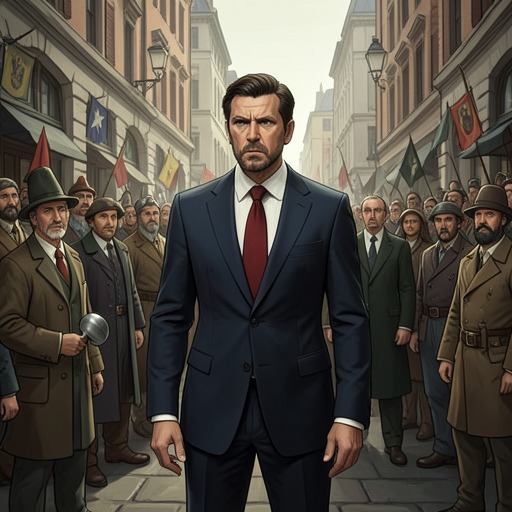
McConnor is introduced as stocky, broad-shouldered, and physically imposing, with a powerful, nearly square jaw, strong teeth, and a conspicuously ruddy complexion. The narrator connects that redness, at least in part, with generous whisky consumption. His broad, athletically forceful build seems to carry over into his chess: he plays with the same assertive, heedless energy with which he has made his way in life.
His success has made him unshakably confident in his own superiority. A loss in an inconsequential game feels to him like an affront to his personal standing, and he treats opposition as something close to insubordination. The narrator’s description makes McConnor recognizable through this single, persistent trait, but it also shows how that trait shapes the action: his pride is wounded, his competitive appetite is stirred, and the match against Czentovic becomes a matter he intends to arrange personally.
The Shipboard Games
The narrator first encounters McConnor through a chess trap laid in the smoking room. Hoping to attract other players—and ultimately to catch the attention of Czentovic—the narrator and his weaker-playing wife set themselves on opposite sides of a board. McConnor becomes the hoped-for partner: a wealthy engineer who challenges the narrator to play. The narrator soon discovers that a game is never merely a game for him. After losing the first, McConnor grows sullen and attributes the result to inattention; after losing another, he blames noise from an adjoining room. He will not accept a defeat without demanding a rematch.
At first the narrator finds this obstinacy amusing. He then puts up with it as the cost of his larger purpose: drawing Czentovic to their table. That purpose partly succeeds when Czentovic appears in the smoking room and appraises the amateurs’ board. After seeing a move by McConnor, the champion judges the game unworthy of further attention and walks away. The narrator reads the cool glance as a dismissal of the group, but the insult has a more consequential effect on McConnor: learning who has just passed them, he forgets their game and fixes on the prospect of playing the world champion.
Ambition and the Paid Match
McConnor is excited to discover that Czentovic is aboard. His ambition becomes unmistakable: he has never faced a grandmaster except in a simultaneous match against forty players, in which he came close to winning, and he now wants a direct encounter. The narrator declines to introduce himself or solicit a game, reasoning that a world champion would have little interest in amateurs and that Czentovic is not especially open to new acquaintances. McConnor takes the narrator’s reference to “third-rate amateurs” as a personal slight. Certain that a civil invitation cannot be refused, he goes after Czentovic himself, leaving their match unfinished in his impatience.
McConnor returns to report that the champion was stiff and discourteous: Czentovic did not shake his hand and would play only for a fee, citing contractual obligations to his agent. His minimum is 250 dollars for a game. The narrator laughs at the unexpected price of professional chess, but McConnor treats the terms as straightforward. He has agreed to the fee and scheduled the match for three o’clock the next afternoon in the smoking room. In his view, paying an expert is no more unreasonable than paying an available dentist to treat a toothache; a clear cash transaction is preferable to being indulged and then expected to offer thanks. He also observes that he has lost more than 250 dollars in an evening at his club, without playing a world champion.
The decision is not simply a purchase of access. McConnor accepts the prospect of defeat as no shame for an amateur, while still wanting the contest to be real rather than softened by Czentovic. His pride, stung by the narrator’s phrase, helps set a costly event in motion; his money and determination also give the narrator the opportunity he had failed to create by more elaborate schemes. The group quickly informs four or five other chess enthusiasts and reserves the table and its neighbors so that passing passengers will disturb the match as little as possible.
The Match and the Stranger
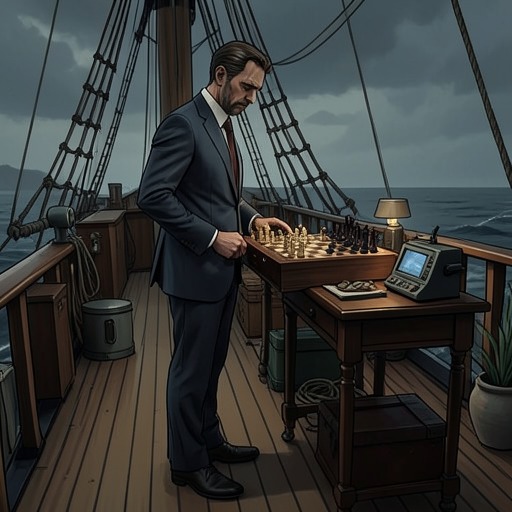
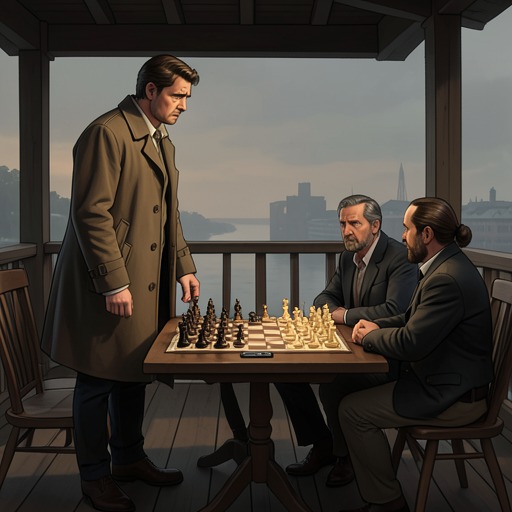
At the appointed hour, McConnor takes the middle seat opposite Czentovic. He manages his nervousness by lighting one heavy cigar after another and repeatedly checking the clock. Czentovic keeps the group waiting ten minutes beyond the agreed time, then begins arranging the game with dry professionalism. Because the ship lacks enough boards for a simultaneous match, he proposes that the group play together against him, moving from table to table after each turn so that their discussion will not be disturbed. McConnor’s eagerness has secured the contest, but the champion controls its terms and atmosphere.
In the ensuing game, a stranger’s intervention changes the balance. When Czentovic asks whether the gentlemen want a third match, his glance goes not to McConnor but directly to the stranger, whose play has marked him as the true opponent. McConnor responds at once, triumphantly demanding that the next contest be between the stranger and Czentovic. Yet the man is still staring intently at the empty board; confronted by the group’s attention, he becomes visibly confused and refuses. He says that he has not sat at a chessboard for twenty, or perhaps twenty-five, years, apologizes for having interfered uninvited, and withdraws from the room before anyone can recover from the surprise.
McConnor’s intervention is decisive but not controlling: he can arrange the paid match and name the new challenger, but he cannot make the stranger accept. The scene reverses his earlier confidence in the contest’s straightforward terms. What began as a businessman’s clear bargain between amateurs and a champion has opened onto a player whose ability commands Czentovic’s attention but whose past makes him recoil from the board. McConnor’s role is therefore catalytic. His pride and initiative bring the players together; his exuberant announcement exposes, in the stranger’s refusal, that the game has become something more complicated than a paid sporting encounter.